Spring 2025
Translating UNICEF's GeoSight into Any Language
Internationalization for UNICEF's GeoSight: a language selector, lazily loaded locale files, and every hard coded string moved behind a translation key. Plus a Story Maps feature.
- frontend
- backend
- open-source
- product
Outcome
GeoSight can now serve its interface in any locale. The team added a language selector that populates itself from the available locale files, moved every hard-coded string in the frontend behind translation lookups, and extended translation into the Django backend. A Story Maps feature was designed and scaffolded alongside it.
Project Manager for a team of seven, and hands on in a few places. I set up the development server and wrote the documentation for it, worked on moving hard coded strings behind translation lookups, and built the Story Maps feature.
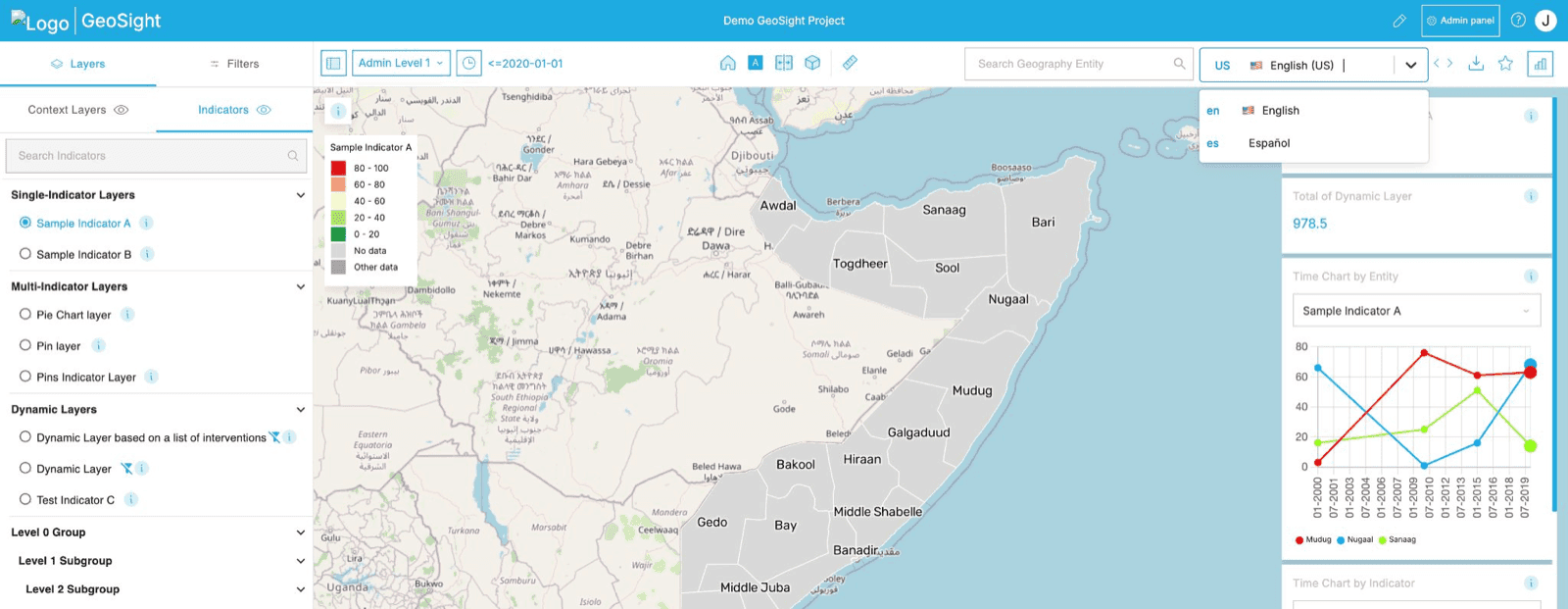
The language selector on the dashboard. The list is built from whatever locale files exist, so adding a language does not mean touching this component.
- 1.Languages are read from the locales folder, and the active one is carried in the URL
Motivation
GeoSight supports humanitarian planning at subnational level, and the people doing that planning do not all work in English. If the interface only speaks English, it is not much use in a lot of the places it is meant to serve.
One semester, working on a fork of a live open-source platform with changes to be brought back to the main codebase.
Experience, learning & skills
- Built and documented the development server setup, which is where contributors to this codebase most often stall
- Built Story Maps: sequences of slides that walk a viewer through predefined map pages, with a schema, an admin-panel toggle, reordering, and per-slide descriptive popups
- Contributed to moving hard-coded interface strings behind translation lookups
- Led the project across a full semester to client handoff
Technical details
The language selector is a React component that populates from the locale files present, with the active language carried in the URL route. Translation uses react-i18next with language files loaded only when needed, so supporting more locales does not slow the interface down. Every hard coded string became a t('page.key') lookup against one shared dictionary, and translations were extended into Django. Story Maps are sequences of slides that walk a viewer through predefined map pages. They got a schema, an admin panel toggle, a reordering dropdown, and a descriptive popup per slide.