Spring 2026
An MCP Server for UNICEF's Geospatial Platform
An MCP server that lets AI agents query UNICEF's GeoSight and GeoRepo directly. Over 20 tools, deployed, with a chat interface on top.
- backend
- product
- open-source
- data
Outcome
A deployed MCP server exposing more than 20 tools over UNICEF's GeoSight and GeoRepo APIs, plus a web chatbot that uses them to answer questions from real humanitarian geospatial data and return charts, graphs, and maps alongside the text.
Project Manager for a team of seven. I scoped the work and wrote some of the tooling, but the build belonged to the team, and my job was getting it delivered through them. Weekly client calls with UNICEF from February through to the May handoff.
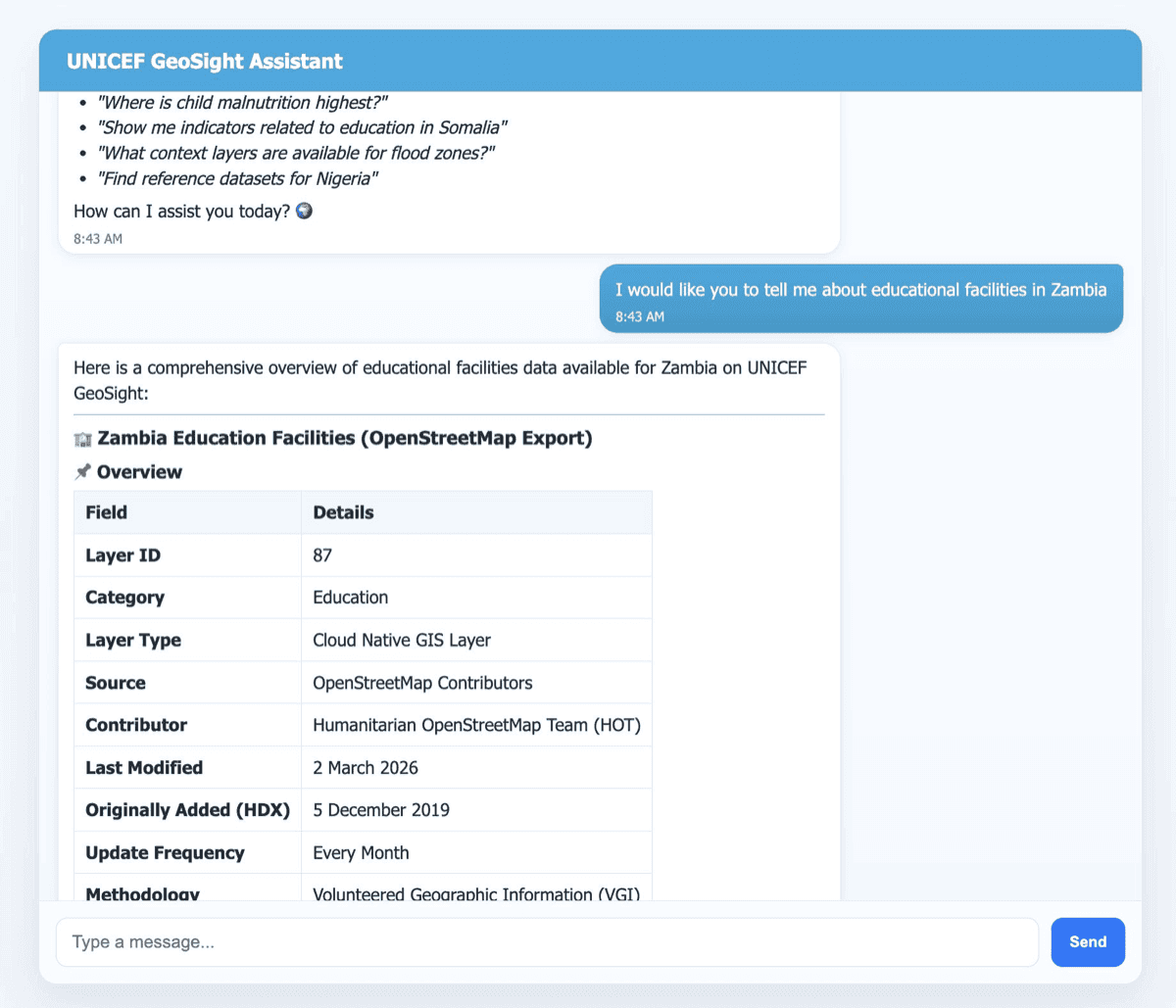
The assistant answering a real question against live GeoSight data. The table is assembled from tool calls, not pasted into the prompt.
Motivation
GeoSight exposes its data through REST APIs, but as analysts increasingly work through AI assistants there was no governed, self-describing way for an agent to reach it. An MCP server gives any agent a discoverable set of tools over the same data.
One semester, building against a live client's platform with weekly calls and a fixed handoff date.
Experience, learning & skills
- Led the project from orientation to client handoff across a full semester
- Ran weekly client calls with UNICEF, carrying feedback into the following week's work
- Delivered a midpoint and final report to the client, plus deployment documentation
Technical details
The server is built on FastMCP, with each tool a registered function that maps its arguments onto a GeoSight or GeoRepo API call. Tools cover basemaps, context layers, dashboards, indicators, reference datasets, related tables, and plotting; name and description parameters compose so a query can union or intersect matches. The plotting tool returns base64 encoded PNGs (line, bar, pie, and world maps) that drop straight into a chat interface. Deployment converts the server to a Starlette web app on Render with slowapi rate-limiting middleware and Streamable HTTP over POST. A FastAPI layer exposes the agent itself over HTTPS, and a toggleable "streamable thinking" mode makes the model explain which tool it is calling and why, which is how you debug it.