Fall 2024
Document-Relevance Tracking for an Offline Disaster LLM
Built document-relevance tracking for a locally-hosted LLM platform serving disaster zones, so responders can see which sources answers are coming from.
- backend
- data
- ml
- product
Outcome
A locally-hosted LLM platform that works without internet access, for use in disaster zones. The document-relevance tracking shows which documents the retrieval pipeline draws on: a per-document usage counter, a log of queries and responses, and source cards plus a relevance chart so a responder can see where an answer came from.
Software Engineer on a team of seven. I worked on document-relevance tracking with another engineer, taking the tracking logic and the visualizations together rather than splitting them up. On this one my role was engineering rather than project management.
Motivation
In a disaster zone there is no reliable connectivity, so the model and its documents have to run locally. And if someone might act on an answer, they need to see where it came from.
One semester, building a full RAG pipeline against a live client: authentication, embeddings, query routing, and scaling.
Experience, learning & skills
- Built document usage tracking, incrementing a relevance counter once per query rather than once per retrieval, so repeated chunks from one document do not inflate it
- Logged queries and responses to Postgres for later analysis
- Surfaced relevance as source cards on each chat response and a bar chart on the documents route
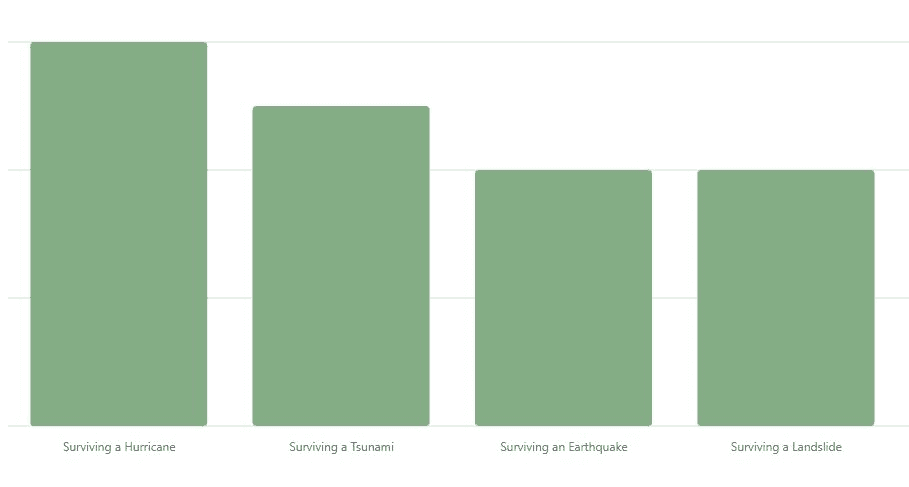
Which documents the system actually draws on, on the /documents route. A document counts once per query, however many of its chunks came back. Otherwise a long document would top the chart just for being chunked more finely.